



















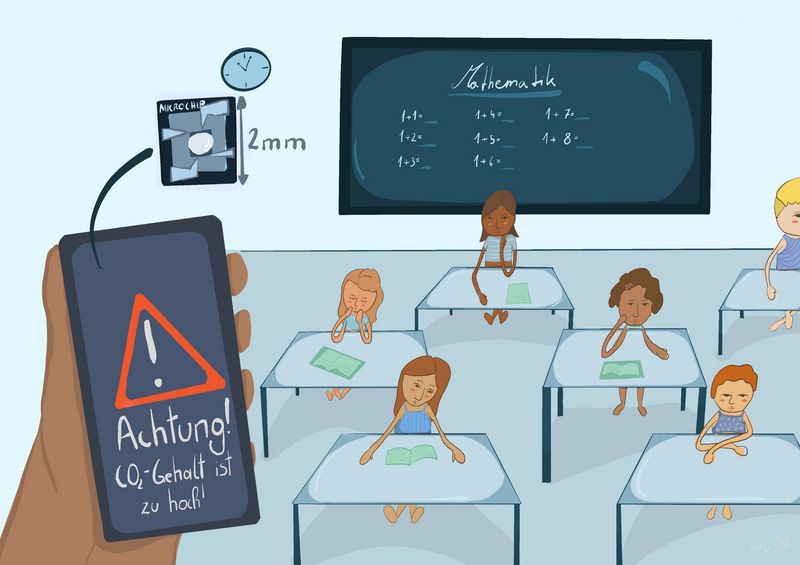
Air quality in classrooms is currently a widely discussed topic and that for good reason. Scientists refer to it as an “invisible danger” that can negatively affect students’ and teachers’ concentration, performance, and overall well-being. In addition, poor indoor air with high CO₂ concentrations can significantly increase the risk of infection.
To address this problem, schools across Austria are currently installing CO₂ measuring devices designed to continuously monitor air quality. Most sensors available on the market rely on optical measurement methods. While these are reliable, their design makes them relatively large and expensive. As a result, they are mainly used as stationary devices installed in rooms rather than as portable solutions.
However, for precise and continuous air-quality analysis, personalized monitoring of CO₂ levels would be highly desirable, ideally directly on the body or in close proximity to every student and teacher, for example through a smartwatch or smartphone. This would make it possible to record individual exposure levels and derive targeted measures.
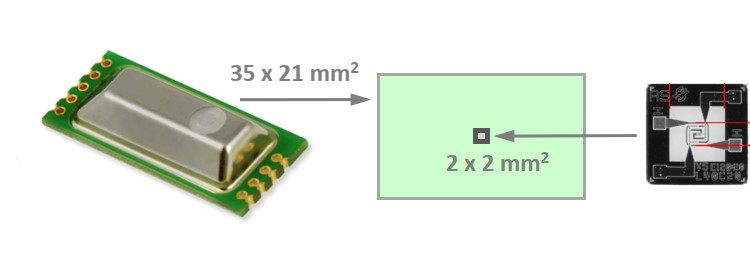
To achieve this, researchers at MCL have developed an innovative alternative to existing measurement systems: miniaturized sensors based on a new nanomaterial system whose electrical resistance changes directly with the CO₂ concentration. These new nanosensors enable CO₂ measurement in extremely small spaces, are more than ten times smaller than conventional models, and could therefore be integrated directly into smartphones or wearable devices.
Impacts and Potential Applications
As part of this project, the first prototypes of miniaturized CO₂ sensors were developed and tested. Their use in compact mobile devices could elevate air-quality monitoring to an entirely new level. Instead of isolated measurements from stationary devices, comprehensive real-time monitoring would become possible. By integrating the sensors into smartphones or smartwatches, personal analysis could be available anytime and anywhere. For example, air quality while studying could be monitored not only at school but also at home or in the office. The developments presented here are based on extensive research work documented in several scientific publications.
Project Coordination (Story)
Dr. Larissa Egger
Senior Scientist Sensor Solutions
Materials Center Leoben Forschung GmbH
T: +43 (0) 3842 45922 – 631
larissa.egger(at)mcl.at
IC-MPPE / COMET-Zentrum
Materials Center Leoben Forschung GmbH
Vordernberger Strasse 12
8700 Leoben
T +43 (0) 3842 45922-0
mclburo(at)mcl.at
www.mcl.at
Project Partners
• Materials Center Leoben Forschung GmbH, Austria
• E+E Elektronik Ges.m.b.H., Austria
• Fraunhofer IAP, Zentrum für Angewandte Nanotechnologie CAN, Germany