



















As passengers, we value the environmental friendliness of the railroad and it is important to us to arrive at our destination safely and on time. This requires optimum maintenance of the rail infrastructure and trains. Wheelset shafts are of particular importance in this context. Wheelset shafts are safety-relevant components that are repeatedly subjected to stringent checks not only at the time of delivery but also during operation.
The required inspection intervals depend on a number of different factors. One factor is that the shafts must function reliably until the next inspection even in the event of damage during operation, for example due to stone chips. Another factor results from possible corrosion attack on the wheelset shafts. To counteract the high safety factors associated with corrosion and the associated shorter inspection intervals, wheelset shafts are often coated with a layer of paint as protection against corrosion and/or stone chipping.
Extensive maintenance
These protective layers are of course associated with additional expense and make it difficult or impossible to visually inspect the shaft during an inspection. If maintenance measures such as turning are necessary, the entire shaft protection layer must be removed and then reapplied. This is time-consuming and not at all resource-saving. In the present project, therefore, a way of avoiding the coating layer was sought. In past work, it has already been demonstrated that surface treatment of the shafts by means of deep rolling, due to the compressive stresses introduced in the process, has a significant effect on extending the service life even in the event of damage, which means that the function of the coating as stone chip protection becomes less important.
Deep rolling and corrosion
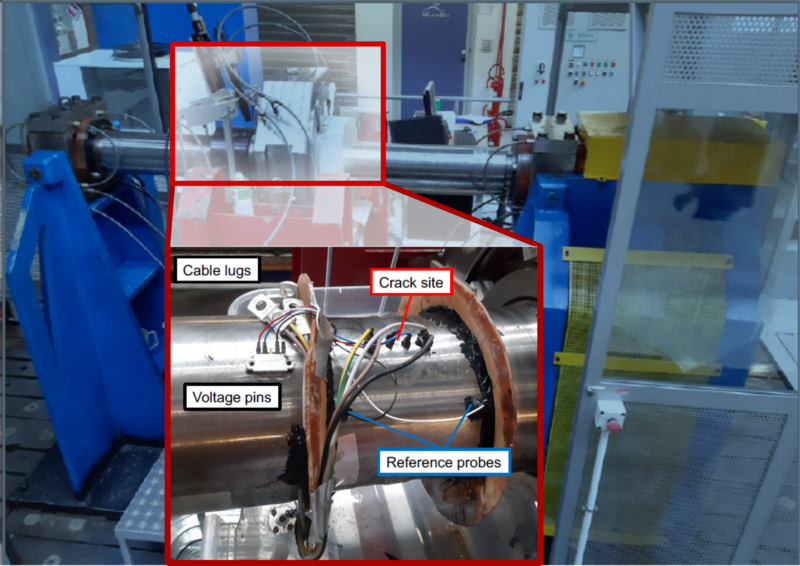
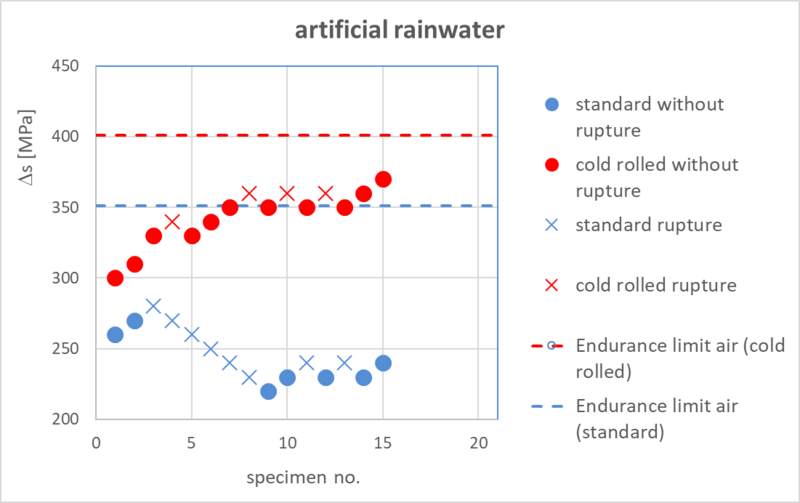
How do deep-rolled shafts perform in a corrosive environment? This question was investigated with the assistance of rotating bending tests. While one half of the rotating bending specimens were deep rolled, the other half remained untreated. The specimens were then sprayed continuously with artificial rainwater during the test and compared with results from standard tests. Figure 2 shows the results: Despite a corrosive environment, the deep-rolled small specimens show fatigue strengths equal to that of standard specimens and are equally well above the required limits. Additional crack growth tests (Fig. 1) have shown that introduced cracks are not or hardly capable to grow even under corrosive conditions.
Effect
Up to five major inspections are carried out on a wheelset axle in the course of its service life. During such a major inspection, the applied anti-corrosion coating must be completely removed and reapplied after appraisal. Deep rolling acts as an environmentally friendly corrosion protection, which also has a very positive effect on fatigue behavior. The costly and often poorly environmentally compatible protective coating thus becomes unnecessary - a significant improvement in sustainability.
Project coordination (Story)
Dr. Jürgen Maierhofer
Group Leader Computational Product Reliability
Materials Center Leoben Forschung GmbH
T +43 (0) 3842 45922-41
Juergen.maierhofer@mcl.at
IC-MPPE / COMET-Zentrum
Materials Center Leoben Forschung GmbH
Roseggerstrasse 12
8700 Leoben
T +43 (0) 3842 45922-0
mclburo@mcl.at
www.mcl.at
Project partners
• Lucchini RS S.p.a., Italy
• HEGENSCHEIDT-MFD, Germany
• Siemens Mobility GmbH, Austria
• ÖBB-Technische Services-GmbH, Austria
• Politecnico di Milano, Italyn
• Montanuniversität Leoben, Austria
• ÖAW, Erich Schmid Institute of Materials Science, Austria