



















It is crucial to understand crack propagation, as it determines the performance of many metallic components under the cyclic loading typical of most applications. Scientists studying fatigue typically distinguish between “short” and “long” cracks. While the propagation of long cracks has been well researched, it is only significant toward the end of a component’s service life. Short cracks are unique in that their resistance to propagation increases as their length increases. Understanding the propagation of short cracks is crucial for improving the fatigue resistance of engineering materials and ensuring longer component lifespans as well as more sustainable use of resources.
However, information on the behavior of short cracks is often obtained from specimens with very deep initial notches. This raises the question of whether data obtained from such standardized specimens is also valid for application-relevant short cracks. Researchers at the Materials Center Leoben, in collaboration with the Erich Schmid Institute for Materials Science and voestalpine BOEHLER Edelstahl GmbH & Co. KG, investigated this question.
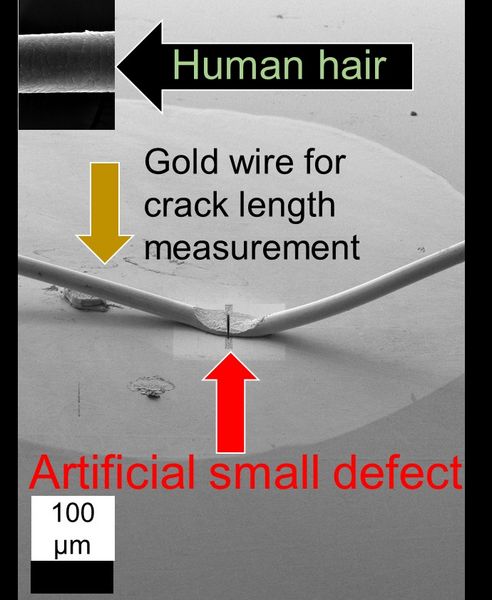
A new testing method was developed to answer this question. The method utilizes the change in electrical potential caused by the growth of a fatigue crack originating from an initial notch measuring just a few micrometers. The potential was monitored with the highest precision using extremely thin gold wires.
Through careful calibration of the testing equipment and a critical comparison with a current, state-of-the-art testing method, the study revealed similar crack growth behavior for cracks originating from deep and microscopic notches. This similarity means that previously generated short-crack fatigue data can be used to describe application-relevant cracks. Furthermore, the developed method offers a ready-made solution for cases where standardized specimens are not available, for example because material for producing large specimens is lacking or because the behavior of application-specific microscopic defect types and shapes needs to be understood.
Impact and effects
The research presented here shows that the fatigue behavior of cracks is comparable regardless of the size of the initial notch. This is excellent news for companies that can use standardized specimens. However, it is even better news for all companies in the aerospace and automotive sectors that frequently need to evaluate the fatigue properties of their materials and, in particular, generate fatigue data from shallow notches, for which no standardized method exists. The developed method is therefore of crucial importance for the Austrian materials manufacturing industry in the development of new high-strength materials, enabling it to compete successfully on the international stage.
Project Coordination (Story)
Dr. Thomas Klünsner
Group Leader Hard Metals, Dept. Materials
Materials Center Leoben Forschung GmbH
T +43 (0) 3842 45922-0
thomas.kluensner(at)mcl.at
IC-MPPE / COMET-Zentrum
Materials Center Leoben Forschung GmbH
Vordernberger Straße 12
8700 Leoben
T +43 (0) 3842 45922-0
mclburo(at)mcl.at
www.mcl.at
Project Partners
• Materials Center Leoben Forschung GmbH, Austria
• Erich Schmid Institute of Materials Science of the Austrian Academy of Sciences, Austria
• voestalpine BÖHLER Edelstahl GmbH & Co KG, Austria