



















The production of steel for automotive and construction applications generates large quantities of CO2, which can be reduced by increasing the proportion of recycled material. Varying base materials with higher recycled content require adaptation of processes to ensure consistent quality. However, steel production is complex and adaptation requires a precise understanding of how individual processes influence the product properties. This is where modern artificial intelligence (AI) modeling approaches come into play. These models are able to extract complex relationships from large amounts of data.
One aspect that is usually ignored is that all measurement data has a certain degree of uncertainty. In addition, the correlations learned by the AI are only accurate where sufficient data is available. The uncertainty of the model therefore increases for process conditions that are not or only slightly represented in the data set.
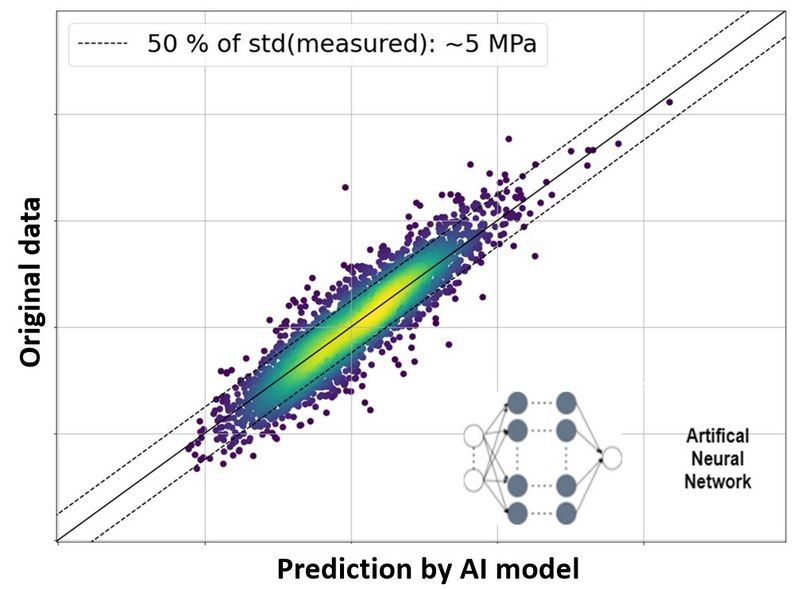
In the “TransMet” project, MCL trained AI models on industrial data for steel production, which can also map uncertainties in the data and in the model itself. The trained AI models were examined using statistical methods in order to extract the learned correlations. It was shown that many of the learned correlations have a physical basis. This approach makes it possible to detect the influence of individual elements and process parameters in large amounts of data, which is the basis for optimizing the production route. In a further step, the AI models were linked to existing physical knowledge of known processes in order to expand the AI models with additional information.
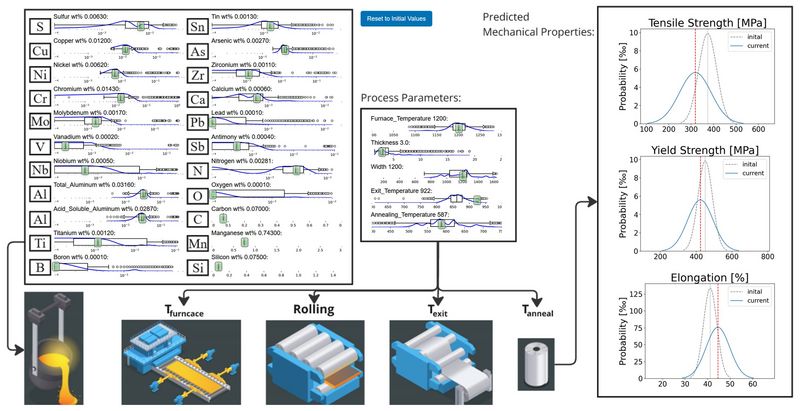
The AI models developed are now being used to determine the influence of impurities from recycled scrap. The new model can be used to optimize processes so that the excellent properties of the steels are retained despite the increased recycled content. The web-based software SteelXplorer was developed at MCL to visualize the predictions and the associated uncertainties in order to make the AI model accessible to users.
Impact and effects
The production of steel is a CO2-intensive and energy-intensive process. The use of scrap instead of primary iron leads to a reduction of up to 1.67 tons of CO2 per ton of steel. With a thorough understanding of the process influences on steel properties, both energy and CO2 can be saved. This is all the more relevant when the effects of impurities from recycling have to be taken into account and compensated for. Modeling with classic simulation methods is impossible, especially for complex process chains with many hundreds of processes.
Through our work, we were able to show that it is possible to integrate existing knowledge in the form of physically-based models into data-driven machine learning approaches. This is an enormous advantage when integrating previously little-researched impurity elements for which the existing data volumes are not sufficient for a purely data-driven approach. This also applies to new process steps that are necessary for green steel with reduced CO2 emissions.
The developed methods establish a framework for AI-driven flexible adaptation of process chains in CO2-neutral steel production, enabling compensation for impurity effects through parameter adjustments guided by limited supplementary experimental data.
Project coordination (Story)
Daniel Scheiber, Manfred Mücke, Peter Raninger
Key Researcher
Materials Center Leoben Forschung GmbH
T +43 (0) 3842 45922-511
daniel.scheiber(at)mcl.at
IC-MPPE / COMET-Zentrum
Materials Center Leoben Forschung GmbH
Vordernberger Straße12
8700 Leoben
T +43 (0) 3842 45922-0
mclburo(at)mcl.at
www.mcl.at
Project partners
• Materials Center Leoben Forschung GmbH, Austria
• Montanuniversität Leoben, Austria
• FH OÖ Forschungs- und Entwicklungs- GmbH, Austria
• voestalpine Wire Rod Austria GmbH, Austria
• voestalpine Forschungsservicegesellschaft Donawitz GmbH, Austria